


Designing Louisiana’s Future: LSU Landscape Architecture Students Tell Community Stories Through Public Spaces
March 17, 2026
Across Louisiana, cities are growing faster than they are being planned. New developments rise, traffic increases, and communities struggle to define public spaces that reflect who they are — and whom they want to become. Add in that access to safe, well-designed public spaces is closely tied to health, resilience, and quality of life.
Students in the Robert Reich School of Landscape Architecture are helping design the places where Louisiana lives, works, and gathers — while learning how thoughtful design can strengthen communities, restore ecosystems, and prepare the state for the challenges ahead.
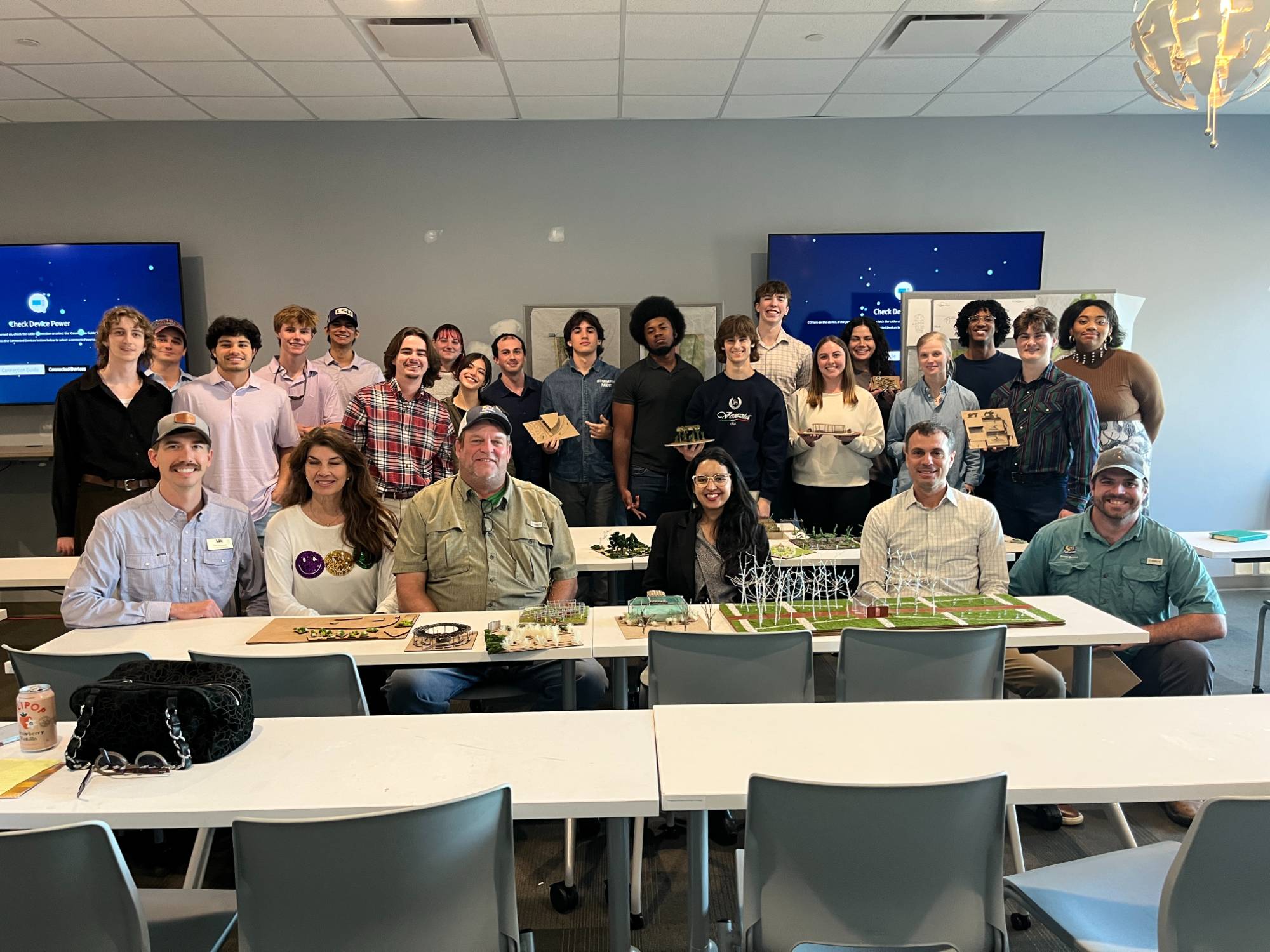
Landscape architecture students presented their micro-farm proposals to the LSU AgCenter Botanic Gardens at Burden Museum and Garden.
“Landscape architects are storytellers; we uncover the cultural, ecological, and social layers that define a community. Through design, we bring those stories forward, shaping spaces that are deeply connected to the people who use them,” said Brian Goad, professional-in-residence at the LSU Robert Reich School of Landscape Architecture and member of the American Society of Landscape Architects.
Nationally recognized as one of the country’s top-ranked landscape architecture programs, LSU’s program pairs its international reputation with a distinctly Louisiana mission: applying design, ecology, and community engagement to real places with real needs. That mission has never been more relevant. Across the state, landscape architects are increasingly called on to address coastal adaptation, post-disaster recovery, urban revitalization, and rapid growth — challenges LSU students are already tackling in the classroom and the field.
LSU landscape architecture students have worked across Baton Rouge and beyond on projects that reflect the evolving needs of Louisiana communities.
Designing a New Civic Identity in St. George
One class project took students to St. George to envision and redefine a central hub for one of Louisiana’s newest cities. The project challenged students to design a multi-use development district while navigating real-world constraints, growth pressures, and infrastructure challenges.
“The St. George project was a collaborative effort to design a central hub for the new city,” said landscape architecture student Luka Hernandez. “Our group focused on a Transit-Oriented Development, an urban planning strategy that creates compact, walkable, mixed-use communities centered around high-quality public transit.”
The students were divided into three teams. One team worked to address issues facing many fast-growing Louisiana communities, including car-dependent infrastructure and the absence of a defined civic center.
“We were asked to address rapid growth, car-dependent infrastructure, and the lack of a defined civic identity,” Hernandez said. “At the same time, the project presented an opportunity to rethink circulation, improve pedestrian connectivity, and create a central place that could serve as a long-term anchor for the city.”
Landscape Architecture as a Tool for Sustainability and Identity
At its core, landscape architecture blends environmental systems with social and cultural needs — a balance that is especially critical in Louisiana.
“Landscape architecture helps communities and cities plan long-term sustainability by working with natural systems, designing adaptable public spaces, and creating places that are both functional and meaningful. It allows cities to balance environmental responsibility with social and cultural identity,” one student said.
Unlike more theoretical studio assignments, the St. George project placed students in direct conversation with stakeholders and decision-makers.
“Knowing the work could influence an actual city made the design process more grounded and intentional.”
"As a new city, St. George is being built in real time, and partnerships like this
allow us to bring fresh thinking directly into that process,” said St. George Mayor
Dustin Yates. “Working with LSU’s students and faculty gives us the opportunity to
test ideas, challenge assumptions, and make more informed decisions as we establish
a strong foundation. We value LSU as a partner and see this as the kind of collaboration
that benefits both students and our city, and it’s a model we intend to continue as
St. George moves forward.”
Students presented their concepts to members of the St. George City Council, who provided feedback and critiques that will help guide future planning discussions — and shape how students approach their professional careers.
Preparing Students to Serve Louisiana
Projects like St. George reflect how LSU’s Landscape Architecture program prepares graduates to contribute meaningfully across the state.
“Partnerships like these allow students to gain real-world experience and prepare us for future careers as landscape architects. They also give cities fresh perspectives and creative ideas while fostering collaboration between academic institutions and local communities,” Hernandez said.
For the students, the work was also deeply personal.
“We’re proud that our design honored the history and culture of Louisiana,” he said. “Our proposal celebrated local identity through spaces that reflect how people here live, gather, and move through the land.”
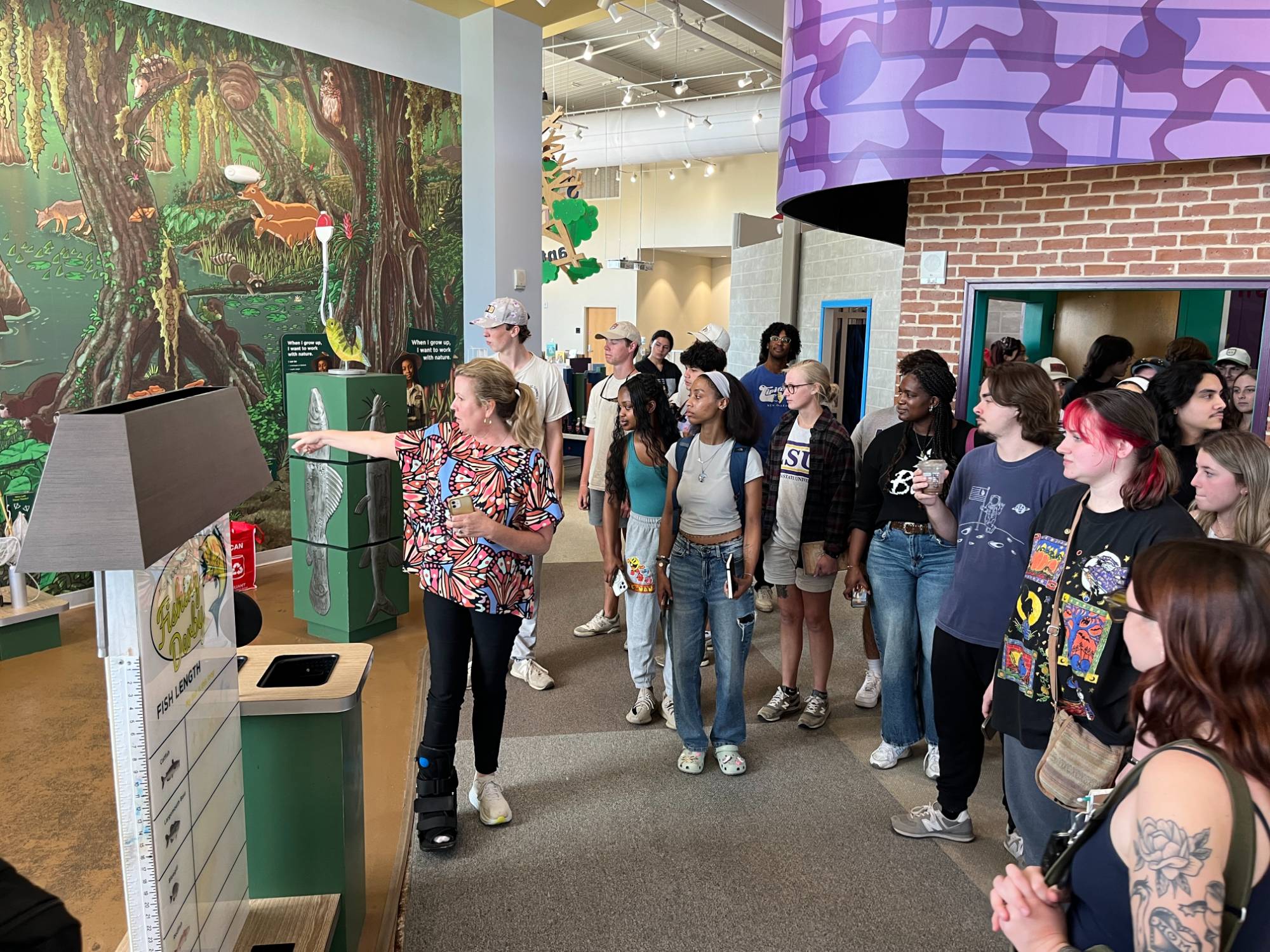
Landscape architecture students on a site visit to the Knock Knock Children's Museum.
In the fall of 2024, students reimagined familiar spaces close to campus through courses taught by Joni Hammons and Brian Goad:
- Sculpting Landscape Experience at Campus Lake, focused on redeveloping a central greenspace on LSU’s campus
- Interpreting Ecologies at DeSoto Park, a downtown Baton Rouge park design developed in partnership with the Downtown Development District
- Interactive Playscape at Knock Knock Children’s Museum, created in collaboration with museum leadership to enhance learning through play
Spring 2025 projects, taught by Goad and Fabiana Trindade da Silva, expanded students’ work into conservation, food systems, and post-disaster recovery:
- A micro farm at Burden Museum and Gardens, developed with the site’s executive director, the director of development, and a research associate.
- A redevelopment plan for the Denham Springs Conservation Area, land that was flooded in 2016, later acquired by the city and transformed into public greenspace in coordination with the mayor’s office
Current second-year studios taught by Trindade da Silva, Goad, and Kevin Benham continue that momentum, including:
- A return to the LSU Campus Lakes and a new project, Building a Better Batture, designing a park adjacent to the Water Campus in downtown Baton Rouge (Fall 2025).
- A Spring 2026 focus on campus and coastal communal landscapes, shifting from public space to the private environments that shape daily life across Louisiana.
Together, the projects reflect a core value of LSU’s program: students don’t just design for hypothetical sites — they design for Louisiana.
From urban parks and children’s museums to conservation areas, coastal systems, and emerging cities, LSU’s Landscape Architecture program is helping shape the future of Louisiana, while training designers who understand the land, the culture, and the communities they serve.
As Louisiana continues to navigate growth, coastal changes, and recovery, LSU landscape architects are already doing the work — one project, one partnership, and one place at a time.